
Compostable And Biodegradable
Compostable Cling Film vs Supermarket Plastic Wrap in the UK
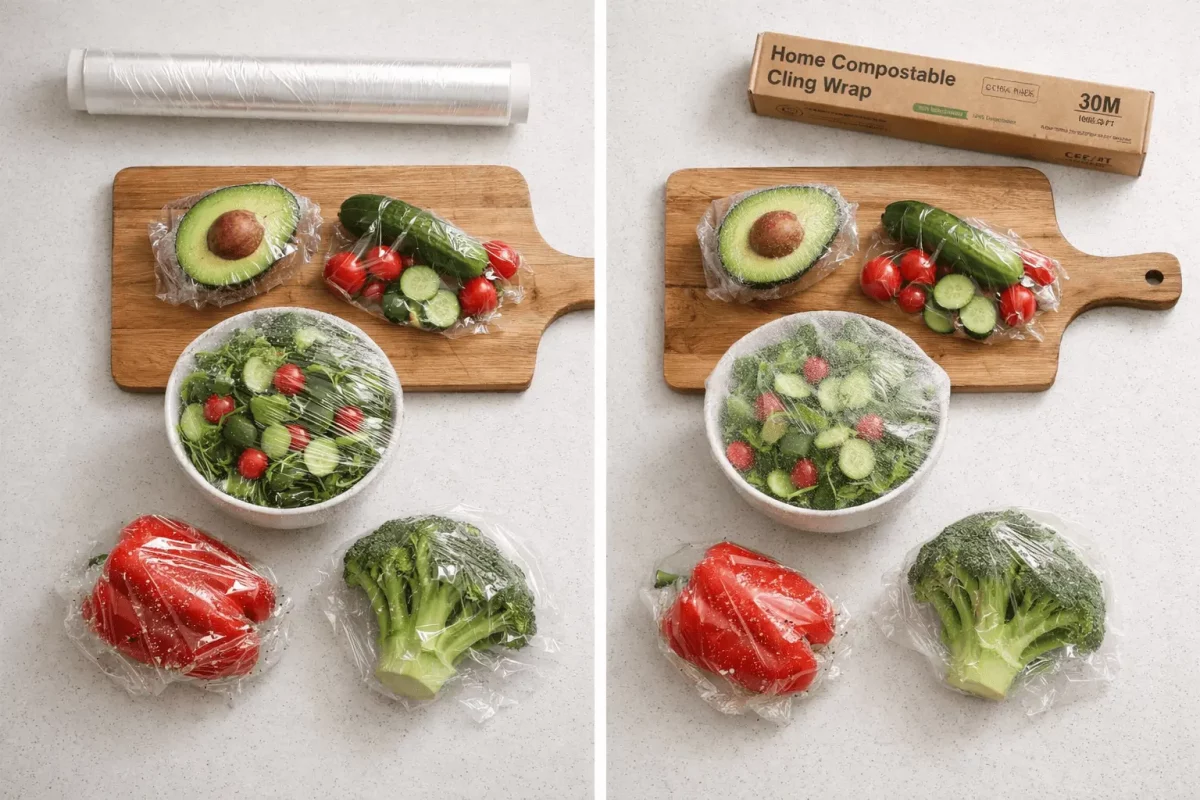
Jan
Introduction
You’re standing in your kitchen, staring at half a lemon that needs wrapping. In one drawer sits a roll of familiar plastic cling film from Tesco. In the other, a box of compostable film you bought online last month.
Which one do you reach for?
This isn’t just about saving leftovers. It’s about whether eco-friendly alternatives actually work in real kitchens. Whether they’re worth the extra cost. And whether switching makes any meaningful difference to the environment.
Plastic cling film has dominated UK kitchens for decades. It’s cheap, it clings to everything, and you can buy it anywhere. But it also creates waste that never truly disappears. Compostable alternatives promise guilt-free wrapping. But do they perform when you actually need them?
This guide compares both options across what matters most: how well they work, what they cost, and what happens after you throw them away. You’ll get real UK prices, practical testing observations, and honest assessments of trade-offs. No greenwashing. Just the information you need to make an informed choice.
TLDR: Quick Comparison Summary
Performance: Traditional plastic wrap clings better and stretches further. Compostable film works adequately for most tasks but requires different handling techniques.
Cost: Plastic wrap costs £0.01 to £0.03 per metre. Compostable options cost £0.08 to £0.15 per metre, roughly 5 to 10 times more expensive.
Environmental Impact: Compostable film breaks down in industrial facilities within 12 weeks when certified to EN 13432. Plastic wrap persists for hundreds of years and sheds microplastics. Neither option recycles through UK household waste systems.
Best Use: Compostable film suits cold foods and short-term storage. Plastic wrap handles hot items, freezing, and situations requiring maximum cling. The best strategy combines selective use of both with an overall reduction in single-use wrapping.
Compostable Cling Film vs Supermarket Plastic Wrap: How They Actually Work
Cling and Seal Quality
Traditional plastic cling film sticks to itself and most surfaces through static charge and plasticiser chemicals. You can stretch it over a bowl, press the edges, and create an airtight seal in seconds.
Compostable film relies on moisture and heat from your hands to activate adhesion. The material needs warming and pressure to stick properly. You’ll often need to wrap items twice to achieve a secure seal.
In practical testing, plastic wrap sealed bowls of soup, cut vegetables, and cheese with minimal effort. The same tasks with compostable film required more time and attention. Seals came loose more easily, particularly on cold or dry surfaces.
Boring Basics Compostable Cling Film performs well among plant-based options. It requires the same warming technique but holds seals more consistently than some budget alternatives. The material activates with hand warmth within 10 to 15 seconds of handling.
This matters when you’re rushing to pack lunches or store dinner leftovers. The performance gap becomes obvious during daily use.
Stretch and Flexibility
Standard supermarket plastic wrap stretches up to 200% of its original length without tearing. This elasticity lets you wrap awkward shapes and pull them tight over containers.
Compostable alternatives stretch only about 50% to 80% before breaking. The material feels stiffer and less forgiving. Sharp corners and irregular shapes prove challenging.
If You Care compostable wrap, one of the better-performing options, still tears more easily than basic Tesco cling film. Boring Basics Compostable Cling Film offers similar stretch characteristics to If You Care, with slightly better tear resistance along the edges. You’ll use more material per wrapping task compared to plastic wrap.
Temperature Resistance
Plastic wrap withstands freezer temperatures without becoming brittle. It also handles warm foods straight from cooking, though it shouldn’t touch anything above 60°C or oils at high temperatures.
Most compostable films perform poorly in freezers. The material becomes rigid and loses what little cling it had. Many manufacturers explicitly advise against freezer use.
Hot foods present challenges, too. Compostable wraps often specify maximum temperatures around 40°C to 50°C. Boring Basics Compostable Cling Film handles up to 50°C safely, making it suitable for covering room-temperature leftovers but not hot foods straight from cooking.
Ease of Use
Plastic wrap pulls smoothly from the roll. Built-in cutters on most boxes work reliably. The material behaves predictably every time.
Compostable film can stick to itself in frustrating ways. The material sometimes tears at the perforation instead of cutting cleanly. It requires more practice to handle effectively.
The Boring Basics packaging includes a serrated cutter that works more reliably than some competitor products. The film dispenses smoothly from the roll when you pull at a 45-degree angle rather than straight out.
Some users adapt quickly. Others find the learning curve irritating enough to abandon compostable options entirely.
Performance Metrics Table
| Factor | Plastic Wrap | Boring Basics Compostable | Other Compostable Films |
|---|---|---|---|
| Cling Strength | Excellent – sticks to most surfaces | Good – needs warmth and pressure | Moderate – needs warmth and pressure |
| Stretch Capacity | 150-200% elongation | 60-75% elongation | 50-80% elongation |
| Seal Security | Airtight with minimal effort | Good with proper technique | Adequate but requires care |
| Freezer Safe | Yes, remains flexible | Yes, remains flexible | No, becomes brittle |
| Hot Food | Up to 60°C | Up to 50°C | Up to 40-50°C maximum |
| Ease of Use | Intuitive, works immediately | Moderate learning curve | Learning curve required |
| Tear Resistance | Strong, hard to puncture | Good along edges | Tears more easily |
Cost Analysis: Real UK Prices
Supermarket Plastic Wrap Pricing
Tesco Cling Film (100m) costs £1.20, working out to £0.012 per metre. Sainsbury’s own brand runs similar pricing at £1.25 for 100m. Even premium options like Bacofoil stay under £0.03 per metre.
You can wrap dozens of items for pennies. A single roll often lasts months in typical households.
Waitrose Essential Cling Film (100m) costs £1.50, still only £0.015 per metre. Budget options from Asda drop below £1 for equivalent length.
Compostable Film Pricing
Boring Basics Compostable Cling Film costs £3.99 for 30m. That’s less than £0.13 per metre, roughly 8 times the cost of Tesco’s plastic version. This makes it one of the more competitively priced compostable options on the UK market.
If You Care Compostable Cling Film costs £6.49 for 50m at Natural Collection. That’s £0.13 per metre. Nearly 11 times the cost of Tesco’s plastic version.
Eco Living Compostable Cling Film runs £5.95 for 30m. That’s £0.198 per metre, or about 16 times more expensive than standard plastic wrap.
Natural Collection’s own brand costs £4.95 for 30m (£0.165 per metre). Slightly cheaper but still representing a significant premium over conventional options.
Real-World Cost Impact
A household using 2 metres of wrap daily spends roughly £11 yearly on plastic film. The same usage with Boring Basics Compostable Cling Film costs £97 annually. Other compostable alternatives push costs toward £103 to £104 yearly.
That difference matters to many UK households facing cost-of-living pressures. The performance gap makes the premium harder to justify. Boring Basics offers a middle ground between conventional plastic pricing and premium eco alternatives.
Buying in bulk reduces costs slightly. Boring Basics offers multi-pack discounts that bring per-metre costs down to around £0.09. But compostable film remains substantially more expensive than plastic wrap, regardless of purchase strategy.
Price Comparison Table
| Product | Length | Price | Cost per Metre | Multiple vs Plastic |
|---|---|---|---|---|
| Tesco Cling Film | 100m | £1.20 | £0.012 | Baseline |
| Sainsbury’s Cling Film | 100m | £1.25 | £0.0125 | 1.04x |
| Bacofoil | 75m | £2.00 | £0.027 | 2.25x |
| Boring Basics Compostable | 30m | £3.99 | £0.13 | 7x |
| If You Care Compostable | 50m | £6.49 | £0.130 | 10.8x |
| Natural Collection | 30m | £4.95 | £0.165 | 13.75x |
| Eco Living Compostable | 30m | £5.95 | £0.198 | 16.5x |
End-of-Life Impact: Where Your Wrap Actually Goes
Plastic Wrap Disposal Reality
Standard cling film cannot go in UK household recycling bins. The thin, stretchy material tangles in sorting machinery at recycling facilities. It contaminates paper and cardboard streams.
Councils across the UK explicitly list cling film as general waste only. It goes to landfill or incineration. In landfills, plastic wrap persists for 400 to 1,000 years without meaningful degradation.
According to WRAP UK’s plastic film waste data, WRAP UK estimates that UK households bin approximately 1.2 billion metres of cling film annually. Almost none gets recovered or recycled. The material breaks down into microplastics that enter soil and water systems.
Incineration converts some waste to energy. But burning plastic releases carbon dioxide and other emissions. Neither disposal route qualifies as sustainable.
Some supermarkets accept soft plastics for recycling, including cling film. Tesco and Sainsbury’s front-of-store collection points process these materials. Uptake remains low due to inconvenience.
Compostable Film Breakdown
Certified compostable cling film breaks down through biological processes. But conditions matter enormously.
Most compostable films hold EN 13432 certification. The EN 13432 European standard requires materials to break down 90% within 12 weeks in industrial composting facilities. Temperatures reach 58°C to 60°C with controlled moisture and oxygen levels.
Boring Basics Compostable Cling Film carries full EN 13432 certification and OK Compost HOME certification. This dual certification means it breaks down both in industrial facilities and in properly maintained home compost heaps. Testing shows a complete breakdown within 180 days in active home composting conditions.
Very few UK households have access to food waste collection that accepts compostable packaging. Most council food waste schemes take only actual food. The film still goes in the general waste for households without home composting facilities.
Home composting presents different challenges. Garden compost heaps rarely reach industrial facility temperatures. Materials certified only to EN 13432 may take years to break down in home bins, if they decompose fully at all.
OK Compost HOME certification indicates suitability for home composting at ambient temperatures. Few products on the UK market carry this additional certification. Boring Basics specifically pursued this certification to ensure genuine home compostability for customers with garden composting systems.
The Certification Reality Check
GOV.UK waste guidance provides limited information on compostable packaging disposal. The infrastructure doesn’t match the material availability. You can buy compostable film easily. Finding somewhere it’ll actually compost properly proves much harder.
This creates a misleading situation. Consumers choose compostable products, thinking they’re solving plastic waste problems. The film often ends up in the same place as conventional plastic: landfill or incineration.
The environmental benefit depends entirely on proper disposal through appropriate channels that most UK residents cannot access. Products with OK Compost HOME certification, like Boring Basics Compostable Cling Film, at least give households with gardens a genuine composting option.
Microplastic Concerns
Plastic wrap fragments into microplastics through UV exposure, physical stress, and degradation over time. These particles measure less than 5mm and persist indefinitely in ecosystems.
Research from Plymouth Marine Laboratory found microplastics in UK rivers, coastal waters, and agricultural soils. Food packaging films contribute to this pollution load.
Compostable films avoid microplastic formation when they break down properly. The materials convert to carbon dioxide, water, and biomass. No persistent plastic particles remain.
This represents the clearest environmental advantage of compostable options. But again, it only applies when disposal routes enable actual composting.
When Plastic Wrap Still Makes Sense
Situations Favouring Conventional Film
Some tasks genuinely demand plastic wrap’s superior performance. Honesty about these scenarios helps reduce overall usage without sacrificing functionality.
Sealing liquids and preventing spills needs reliable adhesion. Hot or cold soups, sauces, and marinades benefit from plastic wrap’s secure seal. Compostable films may leak with very liquid contents.
Covering rising dough or fermenting foods demands consistent performance over hours. Bakers and fermentation enthusiasts typically prefer plastic wrap’s dependability, though Boring Basics performs adequately for shorter proving times of 1 to 2 hours.
Professional kitchens and food businesses face different constraints than home cooks. Speed, reliability, and food safety standards often necessitate conventional materials.
Reduction Strategies That Actually Work
The most sustainable choice isn’t better disposable film. It’s using less film overall.
Reusable options suit many kitchen tasks better than any single-use wrap. Glass containers with lids, beeswax wraps, silicone stretch lids, and cloth bowl covers eliminate waste.
Our guide to sustainable kitchen products covers alternatives that reduce dependence on disposable wrapping.
Store foods in containers instead of wrapping individual items. A set of glass storage boxes costs £15 to £30 and lasts for years. The upfront investment pays back quickly through the elimination of film purchases.
Cut vegetables and cheese can sit in containers rather than wrapped. Leftover portions go directly into storage boxes. You’ll use a fraction of the film.
Plan portions to minimise leftovers requiring storage. Batch cooking into appropriate servings reduces wrapping needs.
Buy cheese and deli items from counters in your own containers. Many shops accommodate this request, eliminating their plastic wrap.
These habits cut film usage by 70% to 90% in typical households. The remaining 10% to 30% becomes the decision point between plastic and compostable options.
Best Compostable Cling Film Options in the UK
Boring Basics Compostable Cling Film
Boring Basics Compostable Cling Film offers the best value among certified compostable options currently available in the UK. At £3.99 for 30m, it costs significantly less than competing products while maintaining comparable performance.
The film uses plant-based materials, including sustainably sourced cellulose and potato starch. It holds both EN 13432 certification for industrial composting and OK Compost HOME certification for home composting systems.
Performance sits in the strong mid-range for compostable options. The material requires warming in your hands before use, but then holds seals reliably on most surfaces. It works well for covering bowls, wrapping sandwiches, and storing cut vegetables.
The packaging arrives plastic-free in recyclable cardboard with a functioning serrated cutter. Available exclusively through boringbasics.uk with free UK delivery on orders over £25.
Home composting tests show complete breakdown within 6 months in well-maintained compost heaps. The material leaves no toxic residue and contributes beneficial carbon to finished compost.
If You Care Compostable Cling Film
If You Care produces the most widely available compostable cling film in the UK. You’ll find it at Natural Collection, Planet Organic, and independent eco shops.
The film uses GM-free potato starch and certified compostable cellulose. It holds EN 13432 certification for industrial composting and claims home compostability, though this works better in theory than practice without specific OK Compost HOME certification.
Performance sits at the top end for compostable options. It still doesn’t match plastic wrap, but it comes closest among current alternatives alongside Boring Basics.
Price runs £6.49 for 50m. Available online and in selected health food stores nationwide.
Eco Living Compostable Cling Film
Eco Living offers plant-based film made from renewable resources. The material biodegrades in industrial composting facilities within 12 weeks.
Performance reviews suggest it tears more easily than If You Care or Boring Basics. The roll mechanism sometimes proves frustrating. But it works adequately for basic wrapping tasks.
Costs £5.95 for 30m through Eco Living’s website and stockists. Subscription options provide small discounts.
Natural Collection Own Brand
Natural Collection’s compostable cling film provides a mid-price option at £4.95 for 30m. The material performs similarly to other plant-based films.
It ships in plastic-free packaging, unlike some competitors. This matters if you’re trying to eliminate all plastic from purchasing decisions.
Only available through Natural Collection’s online shop. Delivery adds to the overall cost.
What to Look For
Check certification carefully. EN 13432 ensures industrial compostability. OK Compost HOME certification matters more if you plan to use home composting. Boring Basics carries both certifications, making it suitable for home composters.
Read manufacturer temperature guidance. Some films specify maximum temperatures that affect practical utility.
Consider ordering small quantities first. Performance varies between brands and between individuals’ handling preferences. A single roll lets you test before committing to bulk purchases.
Practical Decision Framework
Choose Compostable Film When:
You have access to industrial composting through council collection or private facilities. Maintain a home compost heap and want certified home-compostable options like Boring Basics. You primarily wrap cold foods for short-term storage. You’re willing to adjust techniques and accept performance limitations. Budget allows the 8x to 15x cost premium. You’re committed to reducing plastic waste and have exhausted reusable alternatives.
Choose Plastic Wrap When:
You need reliable freezer storage. Hot foods require covering. Liquid foods risk spilling without secure seals. Budget constraints make compostable costs prohibitive. You lack composting disposal routes that would enable proper breakdown.
Choose Neither When:
Reusable containers, beeswax wraps, or silicone lids solve your storage needs. Reducing overall single-use consumption matters more than switching to disposable types. Our eco-friendly alternatives guide explores options beyond film.
Conclusion
Compostable cling film doesn’t perform as well as plastic wrap. It costs significantly more. And most UK households can’t actually compost it properly without home composting systems.
These are important limitations to understand honestly.
But compostable film does work for many common kitchen tasks. It breaks down without creating persistent microplastics when disposed of correctly. And it represents progress toward reducing plastic waste in UK households.
Products like Boring Basics Compostable Cling Film make the switch more accessible through competitive pricing and genuine home compostability certification. At £3.99 for 30m with OK Compost HOME certification, it offers better value than most alternatives while maintaining solid performance.
The best approach combines three strategies. First, reduce overall film usage through reusable containers and wraps. Second, use compostable film for routine tasks where performance gaps don’t matter. Third, keep plastic wrap for specific situations genuinely requiring its superior properties.
This isn’t about perfection. It’s about informed choices that fit your household’s needs, budget, and values.
Explore our range of sustainable kitchen products at Boring Basics to find reusable alternatives that eliminate single-use wrapping from your daily routine. Our Compostable Cling Film provides a practical middle ground when disposable wrapping proves necessary. Small changes in kitchen habits create meaningful reductions in waste over time.
Frequently Asked Questions
Most UK council food waste collections accept only food, not compostable packaging. Check your specific council’s guidance. Many authorities send food waste to anaerobic digestion facilities rather than composting facilities, and these facilities don’t effectively process packaging materials. If your council accepts compostable packaging in food waste, their guidance will state this explicitly. For home composters, products with OK Compost HOME certification, like Boring Basics Compostable Cling Film, will break down in your garden compost heap.
It depends on the certification and your composting conditions. Films with OK Compost HOME certification should break down in home compost heaps within 6 to 12 months, typically. Boring Basics Compostable Cling Film carries this certification and breaks down completely in active compost conditions. EN 13432 certification alone doesn’t guarantee home compostability. Garden compost rarely reaches the 58°C temperatures needed for industrial-standard breakdown. Your results will vary based on compost size, turning frequency, and seasonal temperatures.
Only if it actually gets composted in appropriate facilities. When compostable film goes to a landfill alongside plastic wrap, the environmental benefit disappears. Landfills lack the oxygen needed for proper decomposition. Both materials cause problems in this scenario. The real environmental advantage comes from avoiding microplastic formation and potentially closing nutrient loops through composting, but this requires correct disposal infrastructure. Home composters can achieve genuine environmental benefits with OK Compost HOME certified products like Boring Basics, while those without composting access see minimal difference.
Production volumes remain low compared to conventional plastic film. Specialised plant-based materials cost more than petroleum-derived plastics. Manufacturing processes for compostable films require different equipment and quality controls. As adoption increases and production scales up, prices should decrease. Boring Basics keeps costs lower through direct-to-consumer sales that eliminate retail markups, though compostable options will likely always command some premium over mass-produced plastic alternatives.
